
Rhopilema nomadica
Illustration
Rhopilema nomadica in the Mediterranean: Molecular Evidence for Migration and Insights into Its Proliferation. Zafrir Kuplik, et al.
Life cycle Rhopilema nomadica
2026

Spa DNA
Cover art
Genome Research, vol. 36, no. 1 December, 2025
Automated chromatin profiling with spa-ChIP-seq uncovers the impacts of condition variations. Yuwei Cao, et al.
2025
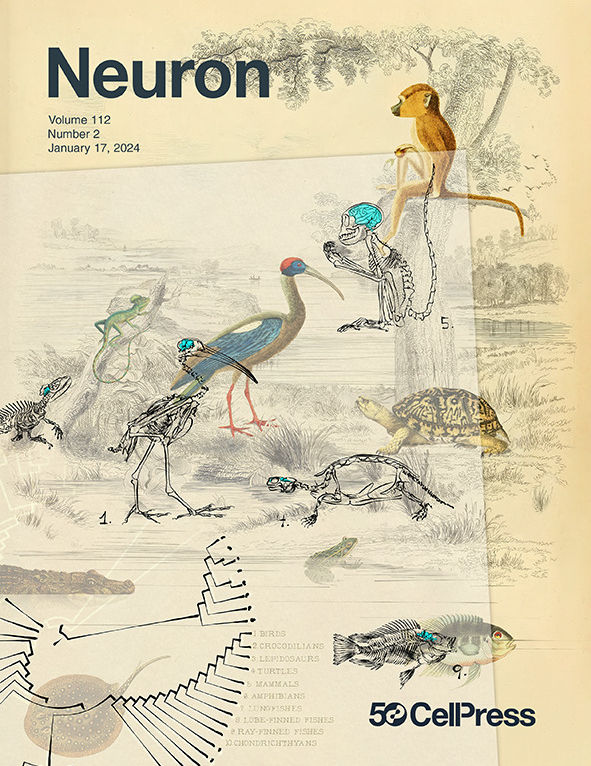
Zoological Collage
Cover art
Neuron, vol. 112, Issue 2, January, 2024
The bone transcription factor Osterix controls extracellular matrix- and node of Ranvier-related gene expression in oligodendrocytes. Benayahu Elbaz, et al.
From the online cover expansion:
"During the evolution from protochordates to jawed fish, the transcription factor Osterix acquired mutations that allowed its interaction with other factors and changed its DNA binding motif. These changes enabled bone formation during evolution. In this issue of Neuron, Elbaz et al. describe how, in parallel, these changes established the transcriptional program that controls extracellular matrix and node of Ranvier formation in the brain. The cover image depicts a portion of a simplified Hillis Plot, which describes evolution based on sequenced genomes, with the evolution from protochordates to jawed fish highlighted. A collage of 19th-century classic zoological illustrations overlaid with simple anatomical sketches sheds light on the evolutionary role of Osterix in brain and bone formation."
2024

Msh3 Mice
Diagram

STRs Mouse
Cover art
Genome Research, vol. 33, no. 5,
A novel quantitative trait locus implicates Msh3 in the propensity for genome-wide short tandem repeat expansions in mice. Mikhail O Maksimov, et al.
In the illustration, a Manhattan cityscape represents Manhattan plots, which are a commonly used visualization technique for genome-wide association studies. The lights on the buildings represent single-nucleotide polymorphisms that have strong associations with the phenotype of interest. A mouse reveals a discovery hidden under the page—variants in a DNA repair gene, Msh3. In this issue, it is determined that inherited variants in Msh3 affect genome integrity by causing instability in lengths of short tandem repeats. The design is inspired by the children's Mouse Book series by Monique Felix.
2023

Recycling Neurons
Cover art proposal
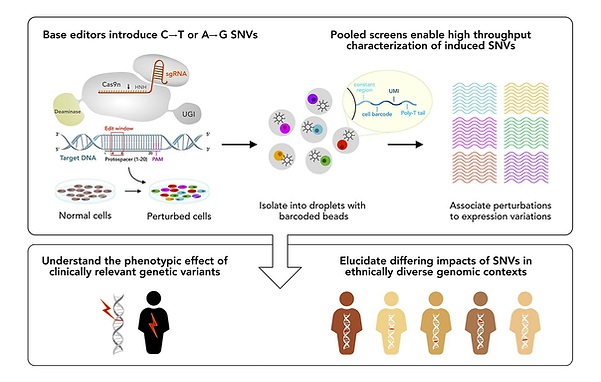
Base Editing Technology and SNVs
Graphical Abstract & Diagrams
Computational and Structural Biotechnology Journal, Volume 20, 2022
The use of base editing technology to characterize single nucleotide variants. Sophia McDaniel, et al.
Diagram graphics based on sketches that were conceptualized by the authors.
2022
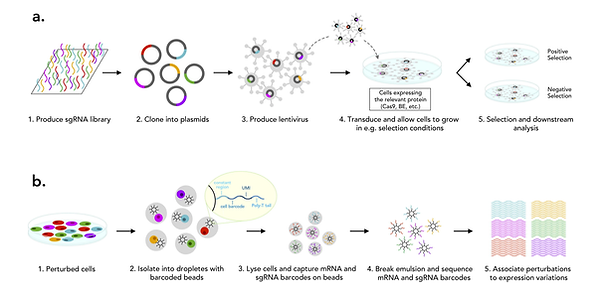


Science Perspective
Overview illustration
Science, vol 373, issue 6562 p.1441, 2021
Missing heritability may be hiding in repeats. Melissa Gymrek and Alon Goren
Diagram modified by the editors for publication
2021

Somatic Truth
Banner art & poster
Nature Communications Biology 3, Article number: 744, 2020
A validated lineage-derived somatic truth data set enables benchmarking in cancer genome analysis. Megan Shand, et al.
Image featured as banner art on Nature Communications Biotechnology homepage (see screenshot)
One of the main difficulties of analyzing sequencing data from somatic (cancer) samples, stems from their inherent noise. In order to properly evaluate and compare different algorithms, robust datasets that separate the noise from the true somatic variation are needed. The paper proposes a dataset of short somatic mutations that are validated using a known cell lineage. The illustration playfully references the biblical story of the tree of knowledge. The fruits in the tree reveal lineage diagrams that are either luminous or ghost-like. The luminous fruit depict mutations that adhere to the lineage structure and thus can be explained by a single event and are considered to be 'true'. The ghost fruit depict, non-real mutations or noise events that do not fall under a single branch of the lineage and are thus labeled as 'false'.
2020


STR Tailor's Tape
Banner art & poster
Nature Genetics 51, 1652–1659, 2019
The Impact of Short Tandem Repeat Variation on Gene Expression. Stephanie Feupe Fotsing, et al.
Image was featured as banner art on Nature Genetics homepage (see screenshot)
The paper examines a type of variation in the human genome called Short Tandem Repeat (STRs) and analyzes its implication in the expression of genes associated with complex traits such as schizophrenia, inflammatory bowel disease, height and intelligence. Referencing the effects of STR variations on height, the illustration depicts one example of an STR, the AC repeat, on a twisted tailor's tape-measure, which evokes the classic structure of double-stranded DNA.
2019


To Bind?
Cover art proposal
Nature Machine Intelligence 3,
172–180, 2021
Deep neural networks identify sequence context features predictive of transcription factor binding. An Zheng, et al.
The transcription process of DNA is highly complex and while short DNA sequence motifs recognized by transcription factors are well known, less is known about the context in the DNA sequence that determines whether a transcription factor will actually bind its motif. This paper presents a method that uses convolutional neural networks to identify sequence features that help predict whether transcribing proteins can bind to their target sequences in DNA
The proposed illustration depicts a stylized DNA strand where some proteins have bound and others have not, according to the prediction model, and the "activity" of one motif along the DNA.
2021

STR Abacus
Cover art proposal
Nature, 589, p. 246–250, 2021
Patterns of de novo tandem repeat mutations and their role in autism.
The paper discusses a connection between a higher number of mutations at short tandem repeats (STRs) and the likelihood of Autism Spectrum Disorder.
In the proposed cover art, an abacus is depicted as a metaphor for the counting process of STR units. DNA strains / rods where more beads have been counted (or moved to the left) are highlighted in ochre, indicating a higher number of repeat copies of the STR within that genome.
2021
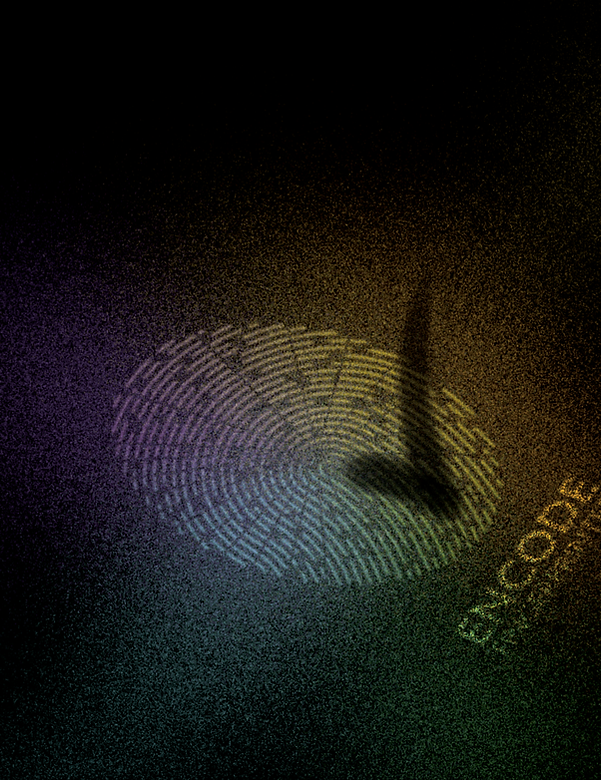
Encode Fingerprinted
Cover art proposal
Nature Communications 11, Article Number: 3697, 2020
Detecting Sample Swaps in Diverse NGS Data Types Using Linkage Disequilibrium. Nauman Javed, et al.
The paper presents a tool for evaluating sample relatedness and detecting incorrectly paired sequencing datasets from different donors. The algorithm was written to be effective even when data are sparse or generated from different assays. It was run against ENCODE data, finding that about one percent of its datasets were mislabeled. In the illustration, the powdered fingerprint is a reference to the process of sample verification. Its pattern and colors are pointing to the iconic ENCODE chromosome boundaries image, seen on the cover of the September 6, 2012 issue of Nature. The checkmark drawn through the powder represents the label verification results.
2020